



In Memoriam: Krisztián Vértes (1976-2025), Part I - A First Reflection
This article is the first in a two-part commemoration of Egyptologist and artist Krisztián Vértes (1976–2025), whose work transformed the practice of epigraphic documentation. Through his founding of digitalEPIGRAPHY and his contributions to major monuments in Abydos, Thebes, and Memphis, he leaves a lasting legacy of innovation, collaboration, and dedication to preserving Egypt’s cultural heritage. Here, we share an overview of his career and the legacy of Digital Epigraphy; a second article will follow with a more comprehensive look at his life’s work and lasting contributions to the field.
Written by Júlia Schmied, Egyptologist, Museo Egizio
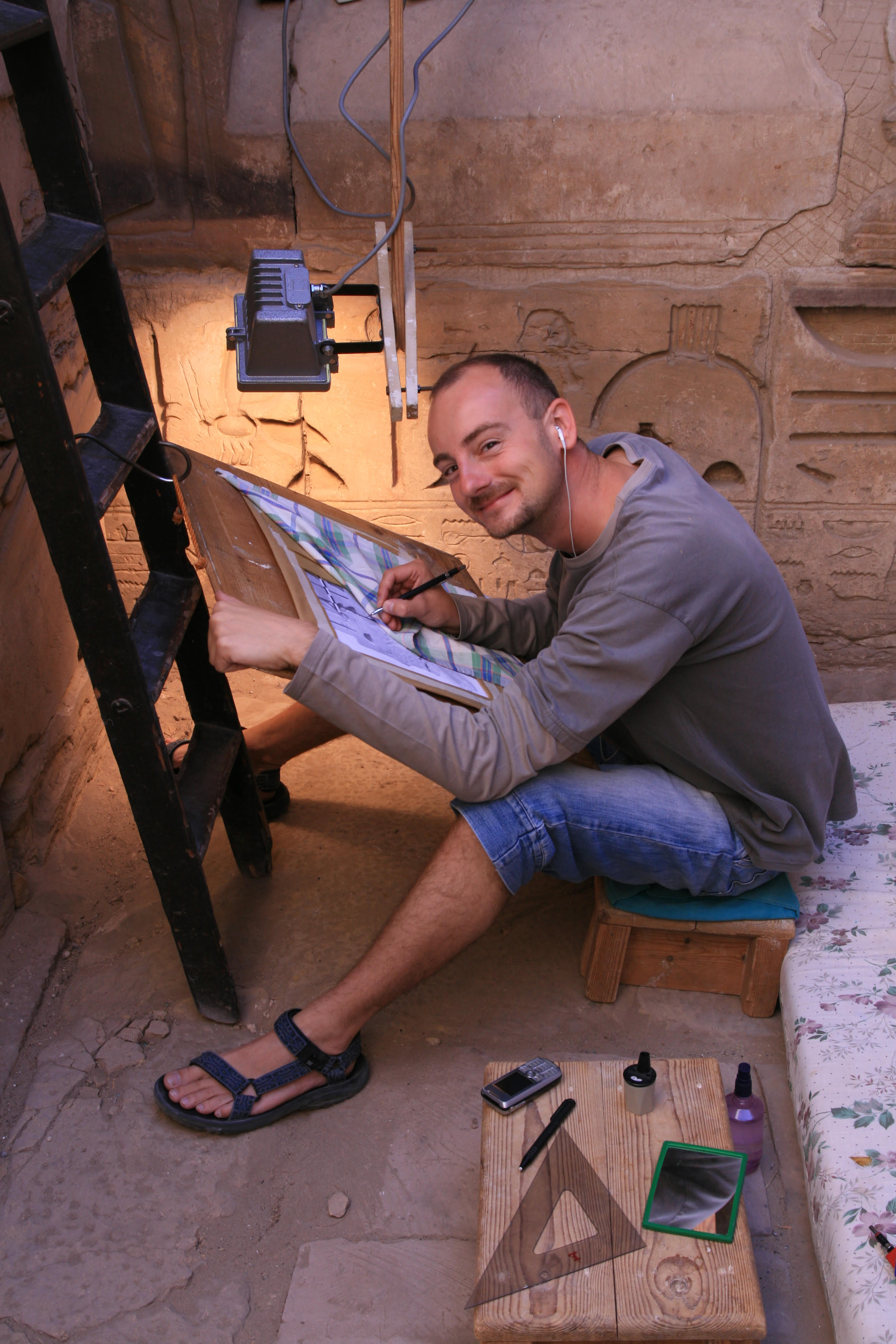
Krisztián Vértes (1976-2025)
Krisztián Vértes was an accomplished artist and Egyptologist whose creativity, dedication, and vision reshaped the way ancient Egyptian monuments are documented. Over the course of his career, he contributed to the study and preservation of some of Egypt’s most important sites, inluding the Small Amun Temple at Medinet Habu, the Temple of Khonsu at Karnak, the Luxor Temple, and the wall paintings of several Theban tombs. Yet what many of his colleagues recall most clearly is not only the precision and artistry of his work, but his generosity in teaching, his restless curiosity, and the enthusiasm that made his presence unforgettable.
After completing his studies in History, Art, and Egyptology at Eötvös Loránd University, Budapest, Krisztián began his career in 1998 in Thebes, where he joined the Hungarian mission directed by Tamás Bács to record the wall scenes in the Tomb of Imiseba (TT 65). In the following years, he extended his work to Abydos, contributing to the documentation of several major temple projects, including the Senwosret III and Osiris Temple projects, as well as at the temple complex of Teti and Iahmes I, working with Josef Wegner, Matthew Adams, and others. Between 2000 and 2004, he also participated in the Eastern Desert Project at Bir Minayh and worked with several other archaeological missions across Egypt, including projects of the Metropolitan Museum of Art (Tomb of Nespakashuty in Thebes (TT 312)), and the Pennsylvania–Yale expeditions (Abydos Settlement Site and Temple Projects). These experiences gave him wide-ranging expertise in documenting wall paintings while also studying painting techniques, materials, and artistic composition.
In 2005, Krisztián joined the Epigraphic Survey of the Oriental Institute, University of Chicago in Luxor, working under the direction of W. Raymond Johnson, where he would remain a central figure for the next two decades. Serving as Egyptologist, Epigrapher, and Senior Artist of digital drawing, he applied his skill and insight to projects including the Luxor Temple Roman Fresco Project, the epigraphic documentation of the Amenhotep Ill wall reliefs in the Chamber of Appearances, and color-enhanced paint reconstruction studies at the Small Amun Temple in Medinet Habu. He combined meticulous accuracy with an artist’s sensitivity, which defined his approach throughout his work at the Survey.
From 2011 to 2019, Krisztián was also part of the Hungarian Archaeological Mission at South Khokha, Luxor, directed by Gábor Schreiber, where he recorded the wall paintings of the Tomb of Nebamun (TT 179). From 2021 onward, he served as epigrapher for the Memphis Hathor Temple Project, directed by Michelle Marlar of the Houston Museum of Natural Science. Most recently, from 2023 until his passing, he worked at the Museo Egizio in Turin at the invitation of Director Christian Greco, where his projects included the documentation of masterpieces such as the statue of Ramses II. He also envisioned new directions for digitalEPIGRAPHY there, exploring how the museum’s diverse collection could provide case studies, resources, and opportunities for international collaboration.
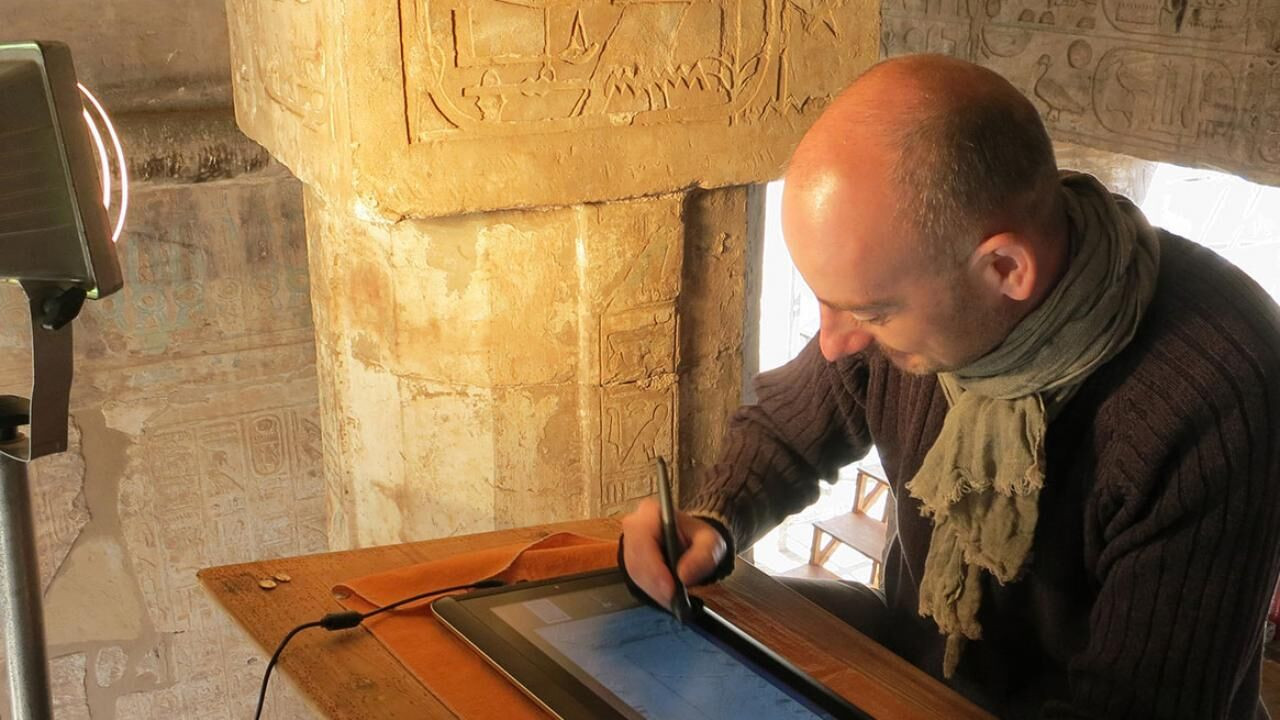
Krisztián in the Small Amun Temple in Medinet Habu, Luxor (Photo by S. Osgood)
Alongside his fieldwork, Krisztián was deeply committed to innovation. With a constant curiosity for new tools and methods, he explored how digital technologies could enhance epigraphic documentation. Beginning in 2012, he introduced digital drawing tablets and specialized software into the Epigraphic Survey’s workflow, applying them across projects from Medinet Habu to Luxor Temple. His vision reshaped the way facsimiles were produced at Chicago House and also encouraged colleagues across the field to embrace new possibilities.
In 2014, he shared his insights in Digital Epigraphy, an interactive eBook published by the Oriental Institute, offering practical guidance for artists and scholars. Recognizing the limitations of traditional publication formats, he went on to establish digitalEPIGRAPHY, launched in 2018 as a flexible and continuously updated platform. Designed as an educational hub, it brought together current tools, techniques, and experiences for Egyptologists and cultural heritage professionals worldwide. Among his digital initiatives hosted on the website, Krisztián led the digitally revised and enhanced edition of The Mastabas of Qar and Idu (G 7101 and G 7102). In collaboration with the Giza Project at Harvard (directed by Peter der Manuelian) and the Epigraphic Survey, he restructured William Kelly Simpson’s 1976 volume as an online publication that restores detail and context — integrating text and images, high-resolution/zoomable drawings, clickable wall maps, archival photographs, and select 3D renderings — setting a model for future digital releases.
Krisztián also led workshops on digital drawing at Yale, Cairo University, Basel, Vienna, Madrid, Leuven, and Copenhagen, where he inspired and trained a new generation of epigraphers and artists. He published widely, with studies ranging from traditional epigraphy to innovative approaches in digital documentation. Among his many publications, the interactive eBook Digital Epigraphy (2014; 2nd ed. 2017) stands out as a landmark in the field. He also contributed chapters to major reference works, including “Tradition and Innovation in Digital Epigraphy” in The Oxford Handbook of Egyptian Epigraphy and Paleography (2020), alongside numerous articles and case studies on Theban tombs and digital documentation techniques. Through these efforts, his influence extended far beyond the projects he directly worked on.

Krisztián in his studio in Budapest
Krisztián’s untimely passing leaves a profound void – for his family and friends, for his colleagues, and for the wider community devoted to documenting and preserving Egypt’s ancient monuments. digitalEPIGRAPHY was not only his professional achievement but also a reflection of his passion, vision, and belief in collaboration. His contribution was transformative: by uniting the precision of traditional epigraphy with the possibilities of digital technology, he created approaches that preserved the artistry of the field while opening it to new directions. In doing so, he set standards that continue to shape how monuments are studied and preserved today. Those who worked with him remember not just a brilliant colleague, but a friend whose humor, intensity, and creativity enriched every project and every conversation. For many of us, it is hard to imagine the field without him, yet his presence remains through the work he created and the inspiration he gave to others. From his earliest work in Theban tombs to his most recent projects at the Museo Egizio, his dedication produced not only meticulous documentation of Egypt’s monuments but also a new vision of what epigraphy could become. He will also be remembered for his generosity in teaching, the patience with which he shared his knowledge, and the enthusiasm that made his ideas so compelling. Above all, those who were fortunate enough to know him will carry the memory of his warmth, his laughter, and the devotion he showed to the people closest to him.
As we look ahead, we remain committed to carrying forward his work. The website he built continues to serve as a vital resource and a meeting place for those engaged in both traditional and digital documentation. Keeping this platform active and growing is our way of honoring Krisztián’s legacy and continuing the work he began. digitalEPIGRAPHY today stands not only as a practical tool for the field, but also as a living tribute to his creativity, generosity, and dedication. His life, so well lived, will endure in the work he created and in the memory of all who had the privilege to know him.
We also hope to continue expanding digitalEPIGRAPHY as a collaborative platform. In the spirit of Krisztián’s vision, we warmly welcome contributions from colleagues and friends — whether articles on projects involving digital documentation, reviews of equipment and software, or reports on new approaches such as photogrammetry or virtual reconstruction. By sharing experiences and insights, we can keep building the community that Krisztián believed in so deeply, and ensure that his work continues to inspire future directions in epigraphy.

Krisztián documenting the statue of Ramses II at Museo Egizio (Photo by W. R. Johnson)
Selected Biography
1998–2004 – Early fieldwork in Thebes (TT 65 Imiseba, TT 32 Djehutimose), Abydos (Osiris Temple, Senwosret III Temple, Teti and Iahmes I), and Bir Minayh (Eastern Desert Project); collaborations with Eötvös Loránd University, Budapest, the Metropolitan Museum of Art and the Pennsylvania–Yale expeditions.
2005–2025 – Epigrapher, Epigraphic Survey, Oriental Institute, University of Chicago, Luxor.
2011–2019 – Epigrapher, Hungarian Archaeological Mission at South Khokha, Luxor (TT 179 Nebamun).
2021–2025 – Epigrapher, Memphis Hathor Temple Project, Houston Museum of Natural Science.
2023–2025 – Epigrapher, Museo Egizio, Turin.
Selected Bibliography
Vértes, K. Digital Epigraphy (2014; 2nd ed. 2017). Oriental Institute, University of Chicago.
Vértes, K. 2018. “The ‘Abydos Pilgrimage’: A Reconstruction Sequence of Scenes in Theban Tomb 179.” Hungarian Archaeology E-Journal.
Vértes, K. 2019. “Documenting and Reconstructing the Late Roman Murals in the Roman Vestibule at Luxor Temple.” Paper presented at ICE XII, Cairo.
Vértes, K. 2020. “Tradition and Innovation in Digital Epigraphy.” In The Oxford Handbook of Egyptian Epigraphy and Paleography. Oxford: Oxford University Press.
A full list of Krisztián Vértes’s publications and lectures will be made available on this site.
1 comment(s)
Dominique
Oct 27, 2025Dear Juli, what a truly beautifully written commemoration for Krisztián. It’s remarkable how much he was able to achieve and how inspiring all his aspirations and accomplishments . Hard to find words after your own eloquence and invaluable efforts to keep his work moving forward into the future. Looking forward to Part II of this tribute, and reading again and more of digitalEpigraphy’s articles to always remember what those of us in the field are working for, and what we should aspire towards. He is an inspiration and one of a kind. Krisztián passion and contributions will live forever through Egypt. Love to you and your family always, Dominique

Nov 8, 2025Dear Dominique, Thank you for your thoughtful and generous words. It means a great deal to know that Krisztián’s work and vision continue to resonate within our field. I am grateful for your encouragement and friendship, and for your support in keeping his legacy present and meaningful. Much love, Juli
Leave a comment(We'll keep your email address private)