



The Funerary Stela of Maienhekau (ME Cat. 1459) - Epigraphic observations on a usurped monument of the reign of Thutmose III
This article is published as the third instalment in our In Memoriam series, and the first to present Krisztián Vértes’ work at Museo Egizio. With it, we would like to begin sharing his final epigraphic work and the methods that shaped it. The text was originally written by Krisztián and has been lightly reworked for publication.
Júlia Schmied, Egyptologist, Museo Egizio

Introduction
According to its inscriptions, the owner of the Turin funerary stela ME Cat. 1459 was the officer Maienhekau, ship’s standard bearer and bearer of arms of the king under Thutmose III. The monument, however, was not originally made for him. It was first created for an unknown official of roughly the same period and later usurped and extensively modified to suit Maienhekau’s needs.
This “hostile takeover” resulted in the deliberate erasure of more than half of the original decoration, which was then replaced with figures and texts reflecting Maienhekau’s family relations. The stela thus preserves two clearly distinguishable decorative phases, closely spaced in time, yet conceptually distinct. Any epigraphic study of the monument must therefore address this duality, while also recognizing that the present appearance represents Maienhekau’s intended final outcome.
Pierre-Marie Chevereau has already dedicated a comprehensive study to Maienhekau, comparing the Turin stela with two further monuments (Louvre C 59 and the Montbarbon stela).[1] Rather than revisiting those comparisons, the present article focuses specifically on epigraphic observations derived from a close visual and technical examination of ME Cat. 1459.
Epigraphic Method
To record and visualize the complexity of the stela’s surface, the original and modified decorative elements were documented separately. Using digital drawing methods proved ideal for this purpose.
The initial “pencil” drawing was created on an iPad using Procreate, with two folders of layers corresponding to the original and secondary phases. Each folder contained both relief features and surviving paint remains. This separation allowed the two phases to be clearly distinguished during later stages of digital “inking” and analysis.
A detailed 3D model of the stela, produced by Museo Egizio photographers Nicola Dell’Aquila and Federico Taverni, served as the basis for an orthorectified photographic background. A modified version of the model was also transferred to the iPad and viewed simultaneously with the drawing process using Emb3d, a lightweight 3D visualizer that allows intuitive interaction with the textured model. Used together, the orthomosaic photograph and the manipulable 3D model provide a close substitute for direct contact with the object, although consultation of the original during drawing and collation remains essential.
Due to the relatively small size of the stela, the final drawing was produced at 1:2 scale, allowing even the smallest details to be recorded accurately.
Relief and paint remains were treated using two distinct visual systems. Relief was rendered as a sun-shadow line drawing with variable line weights to indicate depth and carving technique. This proved particularly effective in distinguishing between the raised relief of figures and the sunk relief of hieroglyphic text. Painted remains were represented using a greyscale texture system, in which each principal hue (black, dark blue, red, light green/light blue, yellow/pink) corresponds to a specific tonal value. Although the preservation of paint is uneven and often fragmentary, this method allows the stylistic character of both paint phases to be examined without competing with the color orthomosaic.
Damaged areas and deliberately erased sections were indicated using a simplified version of the Chicago method, applied sparingly to convey loss without overwhelming the drawing. All data was recorded in separate layers in Pthotoshop using pixel-based drawing with controlled line weights. Paint layers were reduced to 65% opacity to remain secondary to the relief line drawing while still preserving their information. These settings are non-destructive and can be adjusted for different publication purposes. The overall layer structure is best understood through the comparison drawing prepared for demonstration.
Observations
General Remarks
Stylistically, both decorative phases appear to have been executed within a relatively short period, most likely during the reigns of Hatshepsut or Thutmose III, in agreement with Chevereau’s conclusions. Across the surface, Maienhekau’s interventions are immediately visible: areas of the background were sanded down, covered with plaster, and repainted to accommodate his new decorative program.
First Register
At the top of the stela, the central portion of the curved lunette was completely erased and replaced with a seated figure of Ptah, an insertion that likely reflects Maienhekau’s connection to Memphis. To the left, significant elements of the original program survive, including Osiris Khentamentyu seated in a kiosk, accompanied by Horus Harendotes standing behind him.
When examining the painted remains in the kiosk and its figures, it becomes clear that most original details are lost. In many areas, only the initial underpainting survives, with occasional red outlines that once guided the carving. Representing these traces together with the few preserved surface details can be misleading and must be noted. The misaligned red underpaint on Harendotes’ body (Figure 1) or on Osiris Khentamentyu’s crown should therefore not be taken as evidence of poor execution. Rather, traces such as the delicate blue-yellow inlay on the kiosk poles suggest that the original decoration was finely detailed – an impression reinforced by the well-preserved leopard skin in the second register.
Below the two Anubis figures accompanied by wedjet eyes, most original figures and texts were erased to make room for Maienhekau’s additions. Traces indicate that the original scene included a large offering table and two figures behind it. Of these figures, only the rightmost remains – likely the original dedicator’s son, as the faint textual traces indicate above his head – who was preserved but slightly modified: his right arm was repositioned to hold a vessel pouring water onto a double stand with lotus flower (Figure 2). The original position of the arm was held against the body with an open rather than closed hand, as indicated by the remaining traces. Subtle reworking of the torso and differences in paint tone suggest repainting, although the evidence remains inconclusive. According to Chevereau, the completely erased first figure was most likely shown adoring the gods, with his hands raised above the offering. Only a faint trace of his garment could be identified.
The insertion of Ptah appears somewhat cramped within the existing composition, partially overlapping earlier elements. Nevertheless, surviving paint details indicate that the figure was originally better integrated visually. The repainting of the baseline – from black, preserved only at the far right beneath the figure holding the cloth, to dark blue, the color most used by the new owner – further emphasizes Maienhekau’s intervention. Thick blackish deposits visible on parts of the surface, such as Ptah’s throne or Osiris Khentamentyu’s hands (Figure 3), were omitted from the drawing, as they likely result from paint oxidation rather than intentional design.

Second Register
The second register preserves its original symmetrical composition, depicting two offering scenes arranged around a central axis. In each, a seated deceased couple receives offerings in front of lotus stands. On the left, the libation offering is made by a man in a priestly role wearing a panther skin; on the right, by a man in a kilt holding a duck in his left hand while pouring water from a vessel with his right. While the figures themselves were left intact, all original inscriptions were erased and replaced with new texts identifying the participants as Maienhekau, his wife Khenuttawy, and their sons Nekhemmeshaef and Mekh.
The original layout appears to have suited Maienhekau’s purposes well, possibly influencing his decision to reuse this particular stela. The new hieroglyphic inscriptions, carved hastily in sunk relief and painted blue with red dividers, contrast sharply with the quality of the original carving. Despite heavy paint loss, fine details – such as the panther skin pattern, feathered duck, and Khenuttawy’s braided hair (Figures 4-6) – still hint at the former richness of the decoration.

Third Register
The third register is less well preserved, with approximately two-thirds of the original scene erased and replaced. Only the seated couple on the far left belongs to the initial decoration, suggesting a similar arrangement to the register above. To the right, Maienhekau introduced a new offering scene centered on a large table bearing two circular and two elongated loaves of bread, a cluster of grapes, a basket filled with berries, and a large bouquet of onions. Beneath the table stand two large jars encircled by lotus buds. A priestly figure wearing a leopard skin presents the offering to the seated couple, identified as Maienhekau’s parents, Min and Ryry, while Maienhekau’s daughters Taryry, Ta(net)abou, and Takhat kneel behind him on a ground mat.
At first glance, these additions appear to be merely painted on plaster, with no carving. However, closer examination of the 3D model reveals lightly incised outlines beneath the paint, giving the composition some dimensionality. One should not judge these additions by their current ruinous appearance, as Chevereau does in his article. While carving is minimal, the painted details – particularly in the offerings on the table, the leopard skin of the offering bearer, the lotus flowers held by the daughters, and the braids in their hair (Figures 7-9) – demonstrate considerable care. The entire scene rests on a light green ground line that replaces the original black baseline. The inscription, by contrast, is crudely executed, with hasty and irregular carving, frequent misalignment, and is often difficult to read.

Fourth Register
Finally, a few words on the fourth register at the bottom, which is entirely dedicated to a lengthy funerary offering inscription of Maienhekau. Beneath the present five-row text, faint traces of the earlier owner’s inscription remain visible. These are too fragmentary to allow any reconstruction of their content, as only isolated hieroglyphs survive. It is clear, however, that the original text was considerably shorter, occupying only about two and a half rows, as indicated by the incised dividers.
By contrast, Maienhekau’s inscription fills the entire available surface, leaving space only for a small, stylized figure of the deceased in a praying posture at the bottom left (Figure 10). The text is carved in a cursive, almost handwritten style, with hieroglyphs often appearing uneven, unfinished, or hastily executed (Figure 11). Notably, the inscription was painted in two phases: an initial layer in yellow, later covered with the dark blue that dominates the rest of the stela (Figure 12). While the reason for this change remains unclear, it may reflect an attempt to unify the appearance of the text, even if it was originally conceived to evoke a more precious, gold-like effect.
Additional details include traces of horizontal dividers painted in red – rather than carved – between the rows of hieroglyphs. Beyond minor variations, such as slight differences at the end of the first row and a crack affecting the beginning of the third, the inscription largely confirms Chevereau’s reading and does not alter its overall interpretation.

Conclusion
The epigraphic recording of the funerary stela of Maienhekau pursued two main objectives. First, it aimed to document all surviving surface data – relief, paint, and damage – in a clear and readable visual form, using drawing conventions that enhance rather than obscure subtle details. Second, it sought to highlight the two-stage history of the monument and the considerable effort invested by Maienhekau in transforming an earlier funerary stela into his own memorial (Figures 13-14).
By separating original and secondary phases into distinct yet combinable layers, the documentation allows the stela to be studied both as a palimpsest and as a coherent final composition. Ideally, the drawings should be consulted alongside the high-resolution orthomosaic and layered master file, which together offer a comprehensive record of this complex artifact.
Although these methods proved effective for ME Cat. 1459, no single approach can be applied universally. Each monument presents its own challenges, and epigraphic practice must remain flexible, adapting to the material, historical, and visual realities of the object.
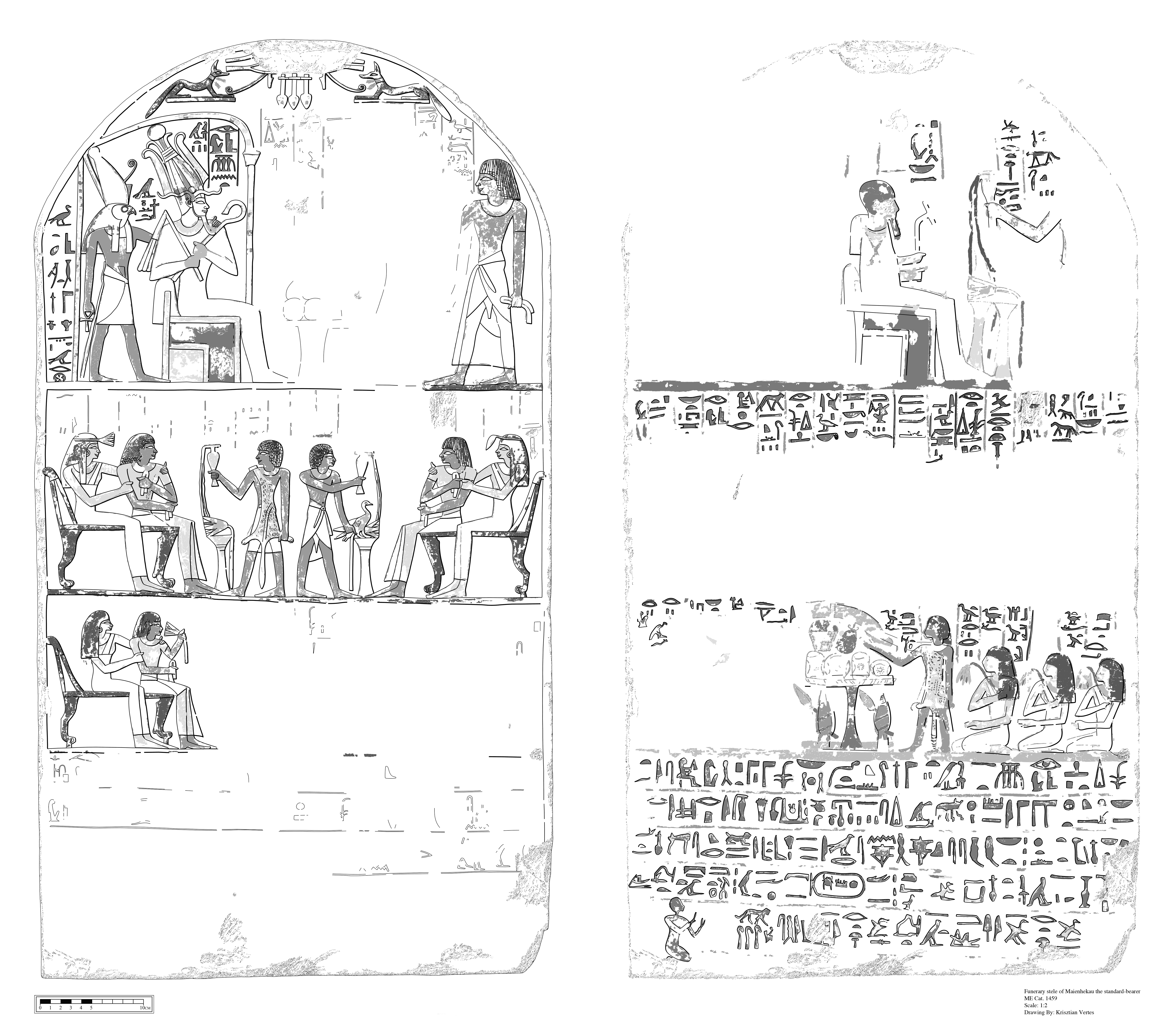
Figures 13-14. Original stela decoration vs. stela modifications and additions by Maienhekau
Krisztián Vértes
Turin, December 31, 2023
°°°
[1] Chevereau, Pierre-Marie, “(Le) porte-étendard Maienheqaou”, Revue d'Egyptologie 47 (1997), pp. 9, 11–15.
0 comment(s)
Leave a comment(We'll keep your email address private)